Scrum the Art of Getting Twice as Much Done
How to apply agile processes to manage your life's projects
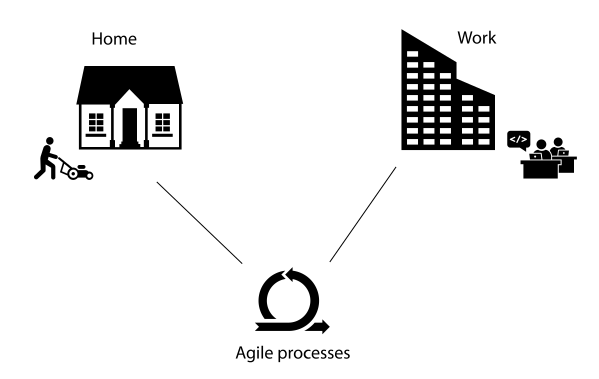
The same scrum approaches used to manage software development projects tin also be used to manage projects in your own personal life. If you follow the core scrum principles, you might actually be able to get "twice as much washed in half the time," as Jeff Sutherland, co-founder of agile, promises.
The claiming of keeping up
At the upcoming TC Camp, during a brief 5-minute feud activeness, Marta Rauch and I are going to provide our perspectives on the following question:
How tin I go along up with all the tools, technologies, info and other stuff to stay marketable? What happened to the expert former days when all you needed to know was FrameMaker?
Absolutely, I can't help but feel caught in the aforementioned technological rat race, barely keeping my head in a higher place water. I practice have some strategies that work somewhat for me, but there is a guy who I call up does have 18-carat insight. His approach is 1 nosotros're all familiar with and use daily in our jobs as technical writers in It environments. Yes, I'thou talking about agile and the scrum principles put frontwards by its co-founder, Jeff Sutherland.
In Jeff Sutherland'due south book Scrum: The Art of Doing Twice the Work in Half the Fourth dimension, Sutherland explains that scrum processes (a type of agile development) aren't just intended for the software industry:
I've seen Scrum used successfully to build cars, run a laundry, teach students in a classroom, make rocket ships, plan a nuptials— fifty-fifty, as my wife has used it, to make sure that the "love-do" list gets done every weekend. The cease results of Scrum — the design goal, if you will — are teams that dramatically improve their productivity. (p. x)
In Sutherland'southward view, scrum is a fashion of completing any projection much more efficiently — in half the time. This approach isn't something that works but for software teams or tech companies. It's an approach for managing any kind of project.
Sutherland explains:
A further of import point: working in a maximally productive manner — the Scrum manner — doesn't have to be bars to business. What if people used this method to accost the large issues our species struggles with — such as dependence on oil, or poor education, or lack of clean water in impoverished parts of the globe, or rampant crime? What if there really was a better way to live and work and solve problems differently? A way we really could change the world? There is. There are people using Scrum to address each of those problems I've mentioned, and they're making a powerful impact." (p. 21)
Can scrum exist used to assistance solve the problem I introduced at the starting time, that of keeping up with the latest technology and data?
I remember it can. Hither's a brief outline of how information technology would piece of work. If y'all're familiar with scrum or agile, you'll recognize the main principles at work here.
one. Define the project
The showtime stride is to envision your tasks equally a "project." (Scrum is a project management approach.)
For example, possibly the project is to be able to read Java code. You've seen this requirement listed on nearly every programmer documentation job ("ability to read code in a major programming language such equally Java, C++, or Python"). By learning to read Coffee lawmaking, you'll be able to increment your tech skills and keep pace with some of the developer doc jobs that are in need in the market.
Sure, reading Java may only be 1 component in a larger project ("Edifice expertise in programmer documentation"), which in plough might be part of an even larger project ("Moving upwardly in your career"), but whether it's a component of one project or another, it's still a project.
ii. Build the excess
Brand a list of all the things you lot take to do to complete the project. This is known equally the backlog. The backlog for a project on developing Coffee expertise might consist of items like the post-obit:
- Read Head First Coffee by Kathy Sierra
- Complete Java course from the Cave of Programming.
- Write a sample Coffee app.
- Generate a sample Javadoc.
- Create a Java project that solves some problem.
- Contribute to Java documentation at a project at piece of work.
When yous finish all of these tasks, you lot'll feel confident that yous'll have completed the project of being able to proficiently read Java lawmaking.
3. Prioritize the excess
Identify the backlog items that will bring the most value. Not everything is ultimately worth doing. Yous should beginning first on the items that deliver the about value. As you make progress, y'all might observe that some of the other tasks aren't every bit important as you thought.
In the case of the Java items, probably contributing to the Java documentation at a work project would exist the about valuable, but you won't be prepared for this until y'all complete the other items.
four. Estimate the size of each backlog item
Assign a relative size to each of the backlog items — modest, medium, or large. Alternatively, give them points equivalent to the Fibonacci sequence.
Sutherland says people are bad at estimating, so you want to compare the tasks to something more familiar, like comparing the tasks to the sizes of dogs. This allows you to make estimations based on relative judgments rather than direct betoken assessments. Is this task a Dandy Dane, Beagle, or Yorkshire Terrier?
Looking at my tasks, here's how I might allocate them:
- Read Head First Java past Kathy Sierra –> Beagle
- Complete Java course on Cave of Programming –> Beagle
- Write a sample Coffee app –> Beagle
- Generate a sample Javadoc –> Yorkshire Terrier
- Create a Java projection that solves some problem –> Great Dane
- Contribute to Coffee documentation at a projection at work –> Neat Dane
Ultimately these relative dog comparisons do equate to numbers. In my scheme, a Yorkshire Terrier might equate to 3 points, a Beagle to 12, and a Great Dane to 34.
5. Programme a sprint
Sprints are usually two-calendar week cycles where you work on items from your backlog. You don't plan all the piece of work for all sprints at once. This is the key idea of agile. You want to complete some work and so evaluate how things are going. Between sprints you determine whether yous should change directions or continue your same focus.
Selection your most valuable items from your backlog and move them into your current dart. For my current sprint, I might get-go with "Reading Head Starting time Java by Kathy Sierra" and "Generating a sample Javadoc."
At first, y'all won't know how many items you can consummate in a sprint. Equally I mentioned earlier, each item has a ready number of story points, which allows you to quantify the piece of work.
Subsequently a few sprints, look at the number of points y'all're completing each dart. This is your "velocity." When y'all know your velocity, you tin projection how long information technology volition take you to complete the project.
half dozen. Hold daily standups
Standup meetings provide short huddles with your team where yous report your status. Your status covers iii things:
- What did you do yesterday?
- What are you going to exercise today?
- Is anything getting in your fashion?
Each morn you can briefly expect at the items in your sprint and single out what you plan to piece of work on for the 24-hour interval. I like to put several post-it notes at the bottom of my computer monitor that refer to the items I'm working on.
Obviously, if you're the only squad member y'all won't have a daily huddle with others, merely you tin can notwithstanding hold a standup with yourself.
7. Complete the dart's tasks
During the two-week sprint, attempt to consummate all the tasks y'all've set out to practise. You shouldn't modify your course during the sprint — y'all work on what yous planned to achieve.
Exactly how should you tackle each sprint item? Well, that's kind of up to you. The key is to consummate information technology. Past the end of the sprint, you should have a functional output that yous can demo.
8. Demo what you've completed at the end of the sprint
At the stop of each sprint, project teams should demo what they've accomplished. The demo should show a fully functional product. Sutherland says that demos are "the most powerful part of Scrum." By "driving toward a demonstrable product on a frequent basis," you lot show that yous're achieving existent value and moving towards your goal (p. xvi).
How would this sprint demo apply if you lot're learning Coffee? Hither'due south one approach. As y'all're learning, take notes. Draft your notes into organized, information-rich nuggets that you lot can read through to review the material. For example, I put some of my notes here:
- JavaScript notes
- DITA notes
- Java notes
By making notes, I'm trying to avoid living the story of Sisyphus, where I continually roll the same boulder up a loma, just to have information technology curlicue back over again. I'm soaking in a lot of new information — through my notes, hopefully I tin can shorten whatsoever re-learning efforts as time passes and my retentiveness fades.
By publishing my set of notes at the end of the dart, I as well demonstrate my knowledge to others.
ix. Get feedback about the results
After the sprint is finished, ask your stakeholders and users for feedback. Are you going in the right direction? Are yous delivering value? Does the production suck or rock?
Certain, you've just finished just a little piece of the solution, just getting this feedback is critical then that you tin can make good decisions for the direction of the project overall. The worst fault you lot can brand is working in a cavern for a year and non emerging until you've finished the whole projection. Past and then, your audience may tell you lot that you've missed the marking long ago.
Sutherland explains that checking for regular feedback is a primal principle of scrum:
At its root, Scrum is based on a unproblematic thought: whenever yous start a project, why not regularly check in, encounter if what you're doing is heading in the right direction, and if it's actually what people desire? And question whether at that place are any ways to improve how you're doing what you're doing, any means of doing it better and faster, and what might be keeping yous from doing that. (p.9)
With our sample projection — learning Coffee — you are your ain audience, so you just need to evaluate whether your effort is helping y'all develop Java expertise. Are yous going in the right management? Maybe the book you're reading is besides advanced. Peradventure you need to switch to video tutorials instead. Perhaps you lot need to do more easily-on coding. Have time to requite yourself some feedback about the direction of your project. Make corrections to better align with this feedback.
If you're working on a modest Coffee projection, show it to a Java programmer to become some feedback. Ask him or her to permit yous know if y'all're doing things right.
You lot could also share your notes with others to become their feedback. Perchance you're misunderstanding some cardinal points. Feedback can help marshal you lot in positive means.
In fact, this is one reason why I publish posts on my weblog. By sharing and getting feedback early in the process, others can give me the insight and feedback I need to correct my course early.
10. Hold a sprint retrospective and strive for "kaizen"
Later on a sprint, identify any impediments or other processes that aren't working. Peradventure you're merely getting a couple of items done each week because you're too tired. Maybe you're spending too much time in your escape zone because you're burned out and are losing energy. Possibly you lot have as well many things going on in your life and need to simplify. Mayhap you lot need to alternate tasks more than to avert getting bored.
Identify some of impediments and remove them. Y'all may not be able to remove them all, simply past removing i or 2 of the things that are dragging you lot down, you lot're putting into practice the notion of "kaizen," which means continuous improvement.
Determination
Although I've been in agile software evolution shops for years, I never thought to utilise scrum to the projects in my own life. I do recall that the same scrum principles that shifted the software industry into greater productivity can be leveraged for ourselves. We are lucky considering most of us are immersed in this process and are familiar with scrum principles, whereas many other industries haven't still adopted it.
What practise you call up? Can you apply scrum processes to amend manage the projects of your life?
About Tom Johnson

I'm a technical writer / API doc specialist based in the Seattle expanse. In this blog, I write near topics related to technical writing and communication — such as software documentation, API documentation, visual communication, information architecture, writing techniques, obviously language, tech comm careers, and more. Cheque out simplifying complexity and API documentation for some deep dives into these topics. If you're a technical writer and want to keep on top of the latest trends in the field, be sure to subscribe to email updates. You tin also learn more virtually me or contact me.
Comments
mcclurecoursentand1937.blogspot.com
Source: https://idratherbewriting.com/2016/01/21/apply-agile-principles-to-personal-projects/
0 Response to "Scrum the Art of Getting Twice as Much Done"
Post a Comment